
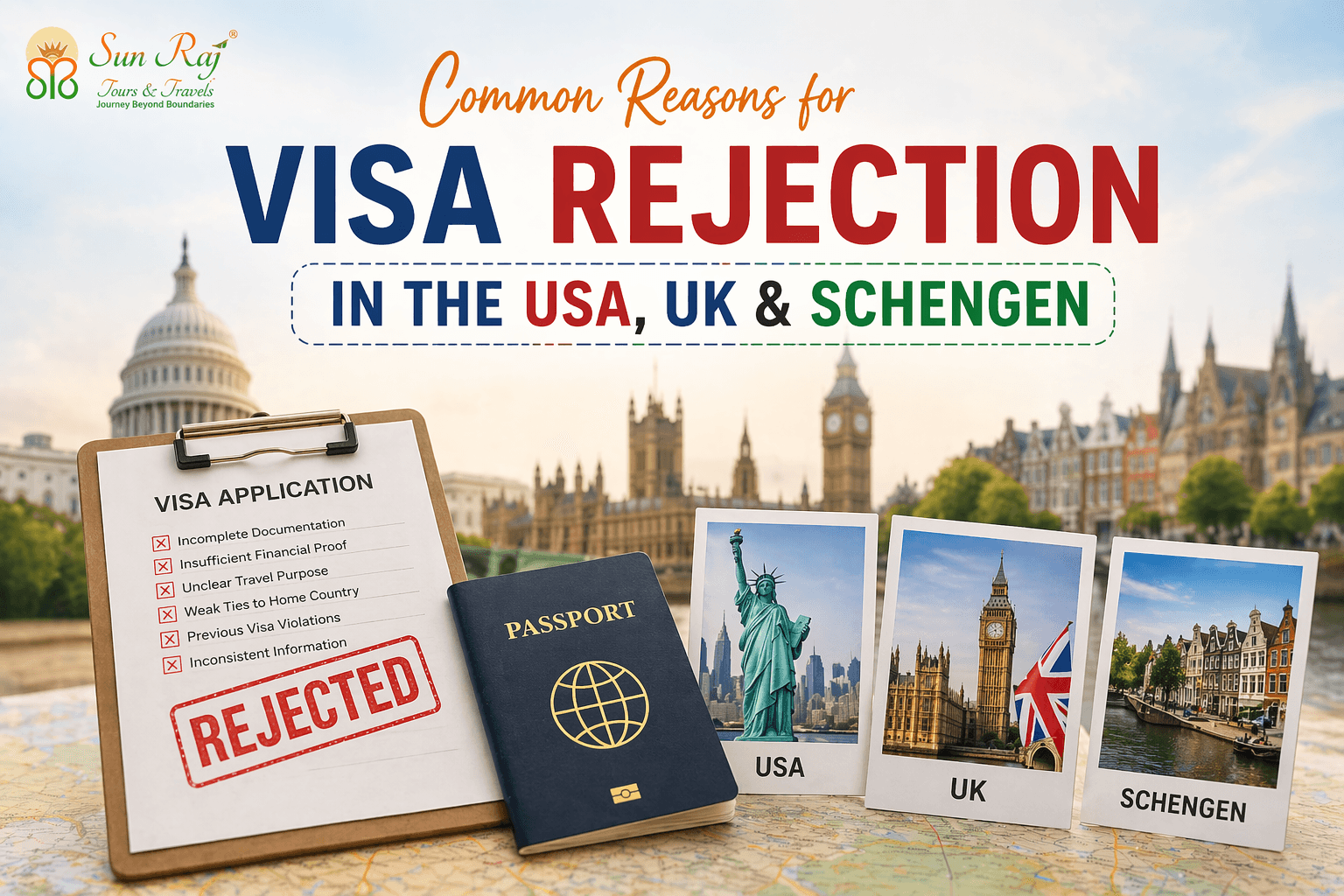
Common Reasons for Visa Rejection in the USA, UK & Schengen
You spent weeks gathering documents. You paid the application fee. You sat through the interview. And then, rejection.
A visa refusal is one of the most frustrating experiences for any traveller. You do not always get a clear explanation. You may not even know what went wrong. And if you do not understand the reason, you risk repeating the same mistake.
That is exactly what this guide is for.
Whether you are applying for a US tourist visa, a UK Standard Visitor Visa, or a Schengen visa for Europe, the visa rejection reasons are often the same, and nearly all of them are avoidable. This blog covers everything: the most common mistakes, country-specific patterns, how to check your visa rejection reason, and what to do next.
Read this before you apply or reapply.
What Does Visa Rejection Actually Mean?
Visa rejection and visa refusal are often used interchangeably. In most countries, they mean the same thing: your application did not meet the required criteria and was denied.
However, there is a technical distinction in the US system:
- Rejection means your application was incomplete and could not be processed. You can refile after fixing the issue.
- Refusal means a consular officer reviewed your case and decided you do not qualify.
- Administrative processing (221g) means the officer needs more information before making a decision.
For most practical purposes — especially for Indian travellers applying to the US, UK, or Europe, a visa rejection means your application was reviewed and denied. You will need to either reapply or appeal, depending on the country.
How to Check Your Visa Rejection Reason?
One of the first questions people ask after a denial is: how to check the visa rejection reason?
Here is how each major destination handles it:
USA
You will receive a written refusal note at the interview or shortly after. The most common code is Section 214(b), which simply means the officer was not convinced you would return home. The note will not explain exactly what swayed the decision. You can review the official US Department of State page on visa denials for more details on each denial code.
For Section 221(g), your case is on hold. You can submit missing documents within one year. After that, you must reapply.
UK
The UK provides one of the most detailed refusal letters of any country. UK Visas and Immigration (UKVI) will specify which requirement was not met. You can also submit a paid enquiry through the official UKVI portal (costs £2.74) to check the current status of your application, but it will not explain the exact reason in real time.
Schengen
Under Schengen rules, you must receive a formal written notice of refusal. It will include a checkbox-style list of the specific grounds for rejection — such as “purpose of stay not established” or “insufficient financial means.” This refusal notice is your key document if you wish to appeal.
General Rule
In most cases, your consulate or visa application centre (VFS Global, BLS, etc.) will notify you by email, SMS, or through the online portal. Log in with your application reference number to access your status. If the portal does not show the specific reason, check your physical refusal letter — it is the most reliable source.
10 Common Visa Rejection Reasons Across All Countries
These visa rejection reasons appear across the USA, UK, Europe, Japan, and Canada. If your application is refused, one or more of these is likely the cause.
1. Insufficient Proof of Financial Means
This is the single most common reason across all countries. Consular officers want to know you can fund your entire trip without working illegally or relying on public funds.
They will look closely at your bank statements. If your balance is low, inconsistent, or shows a sudden large deposit just before applying, it raises a red flag. What they want to see is a steady financial history over the past three to six months — salary credits, existing savings, and a balance that comfortably covers your planned trip.
For a 15-day US trip, you should generally have at least ₹4–₹8 lakhs available. For a Schengen visa, the standard benchmark is €100–€120 per day of stay. Each country has different thresholds, but the principle is the same: show a stable, believable financial picture.
2. Weak Ties to the Home Country
For non-immigrant visas, tourist, visitor, and student, the consular officer must believe you will return home after your trip. If they doubt this, they will refuse.
“Ties to home country” includes your job, property ownership, family responsibilities, business, or education. If you are unemployed, have no dependents, own no property, and have close family members already living abroad, your application will face much greater scrutiny.
This is the reason behind Section 214(b) rejections in the US — arguably the most cited of all US tourist visa rejection reasons. The officer is not convinced your trip is genuinely temporary.
3. Incomplete or Incorrect Application Form
Leaving a mandatory field blank, entering incorrect dates, or making inconsistent entries in your application are surprisingly common errors. It results in immediate disqualification.
For the US, the DS-160 form is critical. From April 2025, the DS-160 barcode number must exactly match the one used to book your visa interview appointment. A mismatch can prevent you from even entering the consulate.
Always double-check every field before submitting.
4. Missing or Inadequate Documents
Each visa category has a required document checklist. Missing even one item — a bank statement, employer letter, travel insurance, or invitation letter — can result in rejection.
Document quality matters too. UK immigration authorities have rejected applications that included laminated, torn, or incorrectly formatted documents. Always submit clean, original, or certified copies.
5. Unclear Purpose of Visit
You must state a clear reason for your travel. If your cover letter is vague, your itinerary is not detailed, or your stated purpose does not align with your documents, the officer will question your intentions.
For example, applying for a tourist visa but submitting an itinerary full of business meetings raises questions. Be specific, be honest, and make sure every document tells a consistent story.
6.No Prior Travel History
First-time international travellers often face closer scrutiny. Approximately 15% of Indian US visa rejections are due to a lack of travel history.
Having previous visas from countries like the UK, USA, Canada, or Australia significantly strengthens your credibility. It signals that you travel and return home as promised.
If you have no prior travel history, other documents — such as strong employment records, property ownership, or family ties — become even more important.
7. Criminal Record or Security Concerns
Any criminal record, regardless of age or severity, can lead to visa rejection. Authorities conduct background checks as part of every application.
In the US, certain criminal offences create permanent ineligibility under Section 212(a). You may need to apply for a waiver, which is a separate and complex process. Honesty is essential here. Concealing a criminal record and being discovered is a far worse outcome than disclosing it upfront.
8. Previous Overstay or Visa Violations
If you have overstayed a visa in any country, even by a few days, it can affect your future applications. Overstaying a Schengen visa, for instance, is logged and can lead to a ban or automatic refusal on subsequent applications.
The same applies to working on a tourist visa or otherwise violating visa conditions.
9. Inconsistent or False Information
Every piece of information across your application — your form, cover letter, interview answers, and supporting documents — must be consistent. Conflicting dates, mismatched addresses, or an interview answer that contradicts your DS-160 can trigger immediate suspicion.
Submitting forged or fraudulent documents is the most severe form of this issue. It results in permanent bans and potential legal consequences. Section 212(a)(6)(C)(i) in the US covers misrepresentation and creates a permanent ineligibility that requires a waiver to overcome.
10. Inadequate or Non-Compliant Travel Insurance
For Schengen visas, travel insurance is mandatory. The policy must cover at least €30,000 in medical emergencies and be valid throughout the entire Schengen Area for the full duration of your stay.
Non-compliant insurance was cited as a reason for 15% of all Schengen visa refusals in 2024. Do not buy the cheapest policy you can find; verify it meets the Schengen requirements before submitting.
US Tourist Visa Rejection Reasons
The US B1/B2 tourist visa is one of the hardest visas for Indian applicants to secure. In 2024, the global B1/B2 refusal rate was approximately 27–30%. For Indian applicants, the tourist visa rejection rate stood at around 16.32%, though student (F1) visa rejections climbed significantly higher.
Here are the specific US tourist visa rejection reasons to know:
Section 214(b) — Presumed Immigrant Intent
This is the most commonly cited reason. Under US immigration law, every applicant is presumed to have immigrant intent unless they prove otherwise. You must demonstrate that your visit is genuinely temporary through strong home ties, a clear itinerary, and a compelling reason to return.
Poor Interview Performance
The B1/B2 visa interview is brief, but it carries significant weight. Officers are trained to detect inconsistencies. Nervous answers, vague explanations, or contradictions between what you say and what your documents show can result in immediate rejection.
Practise your interview. Be specific about your travel plans. Know your documents thoroughly.
Having Close Relatives in the USA
Having siblings, parents, or a spouse already living in the US, especially on green cards or permanent residency, can raise flags about your immigration intent. You cannot hide this information. But you can address it proactively by presenting a very strong case for your return.
Financial Issues
Your bank statements must show genuine, stable funds. Approximately 20% of US visa rejections are related to insufficient finances. Irregular deposits, a sudden influx of cash just before applying, or a balance that is too low relative to your planned trip will hurt your chances.
Social Media Inconsistencies
US consulates increasingly review applicants’ online presence. If your Facebook or Instagram suggests plans that contradict your application — or if you publicly discuss immigration intent — it can affect your case.
UK Visa Rejection Reasons
The UK has a high overall visa approval rate for Indian applicants — around 91% for visitor visas. However, even small mistakes can lead to rejection. Here are the primary UK visa rejection reasons:
Inadequate Financial Proof
You need to show a minimum bank balance of approximately ₹2,00,000 to ₹3,00,000 per person. The UK Home Office will assess whether you can cover your accommodation, travel, and living costs without working or relying on public funds. Bank statements must be recent and reflect a genuine financial position.
Incomplete or Incorrect Documentation
The UK requires a comprehensive documentation package. Missing documents, errors in the application form, or inconsistencies between documents are among the leading causes of refusal. The UKVI is known for strict document scrutiny.
Unclear Purpose of Visit
A vague cover letter or an itinerary that does not match your visa category raises doubts. Whether you are visiting for tourism, attending a graduation ceremony, or visiting family, you need to explain your purpose clearly and submit supporting evidence.
Timing of Application
Applying too close to your travel date is a common mistake. Standard Visitor Visa processing can take 10–15 working days or longer during peak seasons. Apply at least three weeks before your trip, and ideally much earlier if possible.
Previous Overstay or Immigration Violations
If you have previously overstayed in the UK, you may face fines, bans, or even deportation. Any history of prior violations makes subsequent applications significantly harder.
Unclear Study or Work Intentions
For student visas, the UK looks closely at your academic background, the credibility of your study plan, and your financial capacity. Financial issues account for more than 25% of UK student visa rejections in some categories.
Schengen Visa Rejection Reasons
Schengen visa rejections are significant in scale. In 2024, over 1.71 million Schengen visa applications were refused out of 11.72 million — a refusal rate of 14.8%. For Indian applicants specifically, 165,266 applications were rejected in 2024, costing applicants approximately ₹136 crore in non-refundable fees alone.
The top Schengen visa rejection reasons include:
Insufficient Financial Resources (21% of Rejections)
Finances are the top reason for Schengen refusals. The standard benchmark is €100–€120 per day. Bank statements must cover the past three to six months. Large, unexplained deposits made just before applying are a major red flag.
If someone is sponsoring your trip, you must include a sponsorship letter along with their bank statements and proof of your relationship. The sponsor’s financial credibility will be assessed just as closely as your own.
Non-Compliant Travel Insurance (15% of Rejections)
Travel insurance covering at least €30,000 for medical emergencies, valid in all Schengen countries, is a non-negotiable requirement. Many applicants buy cheap or generic policies that do not meet these standards. Always verify compliance before purchasing.
Doubts About Return Intent (12% of Rejections)
Consulates must believe you will return home after your trip. Weak proof of employment, no property, no dependants, or no strong reason to come back are all risk factors. Submit as much evidence as possible — employment letters, property documents, family ties.
Incomplete Application or Document Errors
Missing pages, mismatched dates between your itinerary and travel insurance, inconsistencies in your application form — these lead to immediate rejection. All dates across your flight bookings, accommodation, and insurance must align.
Unclear Purpose of Travel
Vague cover letters or itineraries that do not explain who you are visiting, where you will stay, and why you are going create doubts. Write a detailed cover letter with specific dates, locations, and purpose.
Past Visa Violations
Previously overstaying a Schengen visa is logged in the Schengen Information System (SIS). It can result in a ban from the entire Schengen Area. Violations with any other country’s visa may also be considered.
Refusal Rate Variation by Country
Not all Schengen states apply the same scrutiny. Malta has the highest refusal rate at 38.5%, followed by Estonia (27.2%) and Belgium (24.6%). France, which handles a high volume of Indian applications, has a refusal rate of 15.8%, slightly above the Schengen average.
Japan Visa Rejection Reasons
Japan is increasingly popular with Indian travellers. In 2024, Japan received a record number of tourists from India. However, Japanese visa applications can be rejected, and the reasons are worth understanding clearly.
Japan does not conduct interviews for short-term tourist visas. The assessment is entirely document-based, which makes the quality of your file even more important.
Common Japan visa rejection reasons include:
Insufficient Financial Proof
Japan’s immigration authorities want to see that you can fully fund your trip. Bank statements from the last three to six months, salary slips, and income tax returns are standard requirements. If your balance is too low or inconsistent, your application will be refused.
Incomplete or Inconsistent Documents
Japan visa applications are processed through the Japanese Embassy or authorised travel agents. Any missing document — leave approval letter, confirmed accommodation bookings, flight itinerary, or sponsor letter — can result in rejection. Inconsistencies between documents (e.g., different addresses or dates) are similarly problematic.
Unstable Employment Record
Frequent job changes, gaps in employment, or self-employment without clear proof of income can raise concerns. A steady job with a formal leave approval letter from your employer significantly strengthens your application.
Previous Visa Violations
If you have previously overstayed in Japan or any other country, it can affect your Japan visa application. Japan’s immigration authorities do consider your overall travel history and visa compliance record.
No Clear Return Plan
Much like other countries, Japan wants to be confident that you will leave once your visa expires. A confirmed return flight ticket, hotel bookings for the full duration, and evidence of your ties to India are all important.
Note on Japan Visa Cost from India: The visa fee for a Japan tourist visa is approximately ₹480 (single entry) to ₹960 (multiple entry), excluding service fees charged by the visa application centre. Processing typically takes four to seven working days.
Canada Visa Rejection Reasons
Canada has seen a sharp rise in visa rejections for Indian applicants in recent years, particularly for study permits and visitor visas. Here are the key Canada visa rejection reasons:
Insufficient Financial Proof
Canadian immigration officers assess whether you can fund your stay and return. Low bank balances, recent large deposits without explanation, or inadequate proof of income are common triggers for refusal.
Weak Ties to India
Like other countries, Canada requires evidence that you will return home. Employment, property, and family ties all contribute. Applicants with no strong reason to return face a higher risk of refusal.
Misrepresentation or Document Fraud
Canada treats misrepresentation very seriously. Submitting false documents — including fake employment letters or manipulated bank statements — results in a ban of up to five years from applying for any Canadian visa.
Prior Refusals
A history of visa refusals — from Canada or other countries — can affect your application. You must declare previous refusals honestly. Hiding them and being discovered is significantly worse.
Incomplete Application
Missing documents or unanswered questions on your application form can result in rejection. Double-check the Canadian Immigration and Citizenship (IRCC) checklist before submitting.
Does a Visa Rejection Affect Future Applications?
Yes. A visa rejection can affect future applications, in the same country and sometimes in others.
Here is what you need to know:
- You must disclose previous rejections. Most countries ask on their application forms whether you have been previously refused a visa. Lying about this is considered misrepresentation, which is a far more serious issue than the original rejection.
- Countries share information. Some countries — particularly in shared systems like the Five Eyes group (USA, UK, Canada, Australia, New Zealand) — may have access to each other’s refusal records. The Schengen system also maintains a shared database (SIS).
- Rejection is not permanent. For most visa types, you can reapply after addressing the reasons for refusal. There is no mandatory waiting period in most countries. However, reapplying too quickly — without making meaningful changes — usually results in another refusal.
- Severity matters. A rejection for missing documents is very different from a rejection for fraud or misrepresentation. The latter creates long-term or permanent bans.
What to Do After a Visa Rejection?
Getting refused does not mean giving up. Here is a clear course of action:
Step 1 – Read the Refusal Letter Carefully. Your refusal letter or notice is the most important document you have. Read it word for word. Identify which specific requirements were not met. This is your road map for the next application.
Step 2 – Understand the Rejection Code. For the US, identify whether your refusal was under 214(b), 221(g), or 212(a). Each code means something different and calls for a different response. For the UK and Schengen, the refusal notice will specify the exact grounds.
Step 3 – Do Not Reapply Immediately. Unless your rejection was purely due to a missing document that you can quickly provide, do not rush to reapply. Take time to genuinely address the issue. A new application that does not resolve the original problem will almost certainly fail again.
Step 4 – Consider an Appeal. For Schengen visas, you have the right to appeal within the timeframe stated in your refusal letter — typically within a few weeks. File a formal appeal letter addressing each stated reason. Include additional evidence that was missing from the original application. For UK refusals, you can request an administrative review or apply for a fresh visa, depending on the visa category. For the US, there is no formal appeal for 214(b) refusals. You must reapply.
Step 5 – Strengthen Your Application. Address every weakness. If you were rejected for financial reasons, build a stronger bank balance and history. If you were rejected for weak ties, gather more evidence — an employer letter, a property document, family certificates. If you failed the interview, practise extensively before applying again.
Step 6 – Seek Professional Help If your application is complex — multiple prior refusals, criminal history, inconsistent documents — a professional visa consultant can identify issues that are not obvious and guide your reapplication.
At Sunraj Travels, our visa services team has helped thousands of Indian travellers navigate complex applications and improve their chances of approval. Whether you are applying for the first time or dealing with a previous rejection, we are here to help.
Tips to Avoid Visa Rejection
Prevention is far easier than recovery. Here are the most important steps to take before submitting your application:
Apply Early: Never apply at the last minute. Processing delays, technical issues, or requests for additional documents can extend your timeline significantly. For Schengen, apply no more than six months and no fewer than three weeks before your travel date.
Build and Maintain a Healthy Bank Balance. Avoid depositing large sums just before applying. Show a stable financial history for at least three to six months. Include salary slips, income tax returns, and existing savings.
Write a Detailed Cover Letter. A cover letter is your opportunity to explain your trip clearly. Include your travel purpose, destinations, duration, who you are visiting (if applicable), and your plan to return. Attach a day-by-day itinerary.
Prove Your Ties to India Strongly. Employment letters, leave approval letters, property documents, marriage or birth certificates, and tax returns all help establish your ties to home. The stronger your case for returning, the lower the risk of rejection.
Ensure Travel Insurance Compliance For Schengen visas, verify that your insurance covers at least €30,000, is valid across all Schengen countries, and covers your entire travel period.
Be Consistent Across All Documents. Every date, address, and personal detail across your application form, itinerary, insurance, flight bookings, and accommodation must match. Inconsistencies — even minor ones — raise red flags.
Prepare thoroughly for the interview. For US and UK visas, the interview is critical. Be calm, confident, and precise. Know your itinerary. Know why you are going, where you will stay, how much you are spending, and when you are returning. Do not volunteer information that was not asked, but answer every question honestly and completely.
Declare Previous Rejections. If you have been refused before, declare it honestly. Explain what changed since then. A well-handled previous refusal is far less damaging than a discovered misrepresentation.
Use a Trusted Visa Consultant. Professional guidance reduces the risk of avoidable errors. Our team at Sunraj Travels reviews your documents, identifies gaps, and helps you build the strongest possible application before submission. We also assist with travel insurance, international tour packages, and forex services to make your end-to-end travel planning smooth.
FAQs
Q: What are the most common visa rejection reasons?
Incomplete documentation, insufficient financial proof, weak ties to the home country, unclear travel purpose, and prior immigration violations are the most frequently cited reasons across the US, UK, Canada, and Schengen countries.
Q: How to check the visa rejection reason after refusal?
For the US, check the denial code on your refusal slip (214b, 221g, 212a). For the UK, read your UKVI refusal letter in detail. For Schengen, review the formal refusal notice provided by the embassy. You can also log in to the visa application centre’s online portal using your reference number to check your status.
Q: Can I reapply after a visa rejection?
Yes. Most countries allow immediate reapplication, though reapplying without addressing the original issue is unlikely to succeed. Wait until you can meaningfully improve your application.
Q: Will a visa rejection affect other visa applications?
It can. You must declare previous rejections on most visa application forms. Some countries share immigration data. However, a single rejection — if properly addressed — does not prevent future approvals.
Q: How long should I wait before reapplying after a visa rejection?
There is no mandatory waiting period for most countries (USA, UK, Schengen, Canada). However, you should only reapply when your circumstances have genuinely improved or when you can address the specific reasons stated in your refusal.
Q: What is a Section 214(b) rejection?
Section 214(b) is the most common US visa rejection reason. It means the consular officer was not convinced that you have strong enough ties to your home country to guarantee your return. It does not permanently bar you from applying again.
Q: What is the Japan visa rejection rate for Indians?
Japan does not publish detailed rejection data by nationality. However, most rejections are document-based — incomplete files, financial inconsistency, or unclear travel purpose — since Japan does not conduct interviews for short-term tourist visas.
Q: What are the main Canada visa rejection reasons for Indians?
Weak financial proof, low ties to India, prior refusals, and misrepresentation are the most common reasons. Canada has seen rising rejection rates in recent years, particularly for study permits.
Final Thoughts
Visa rejections are more common than most people realise. In 2024 alone, over 1.71 million Schengen visa applications were refused, and the US saw B1/B2 refusal rates of roughly 27–30% globally.
But the vast majority of visa rejection reasons are avoidable. Strong financial documentation, a detailed and consistent application, genuine ties to your home country, and thorough interview preparation can make the difference between an approval and a refusal.
If you have faced a rejection — or want to avoid one entirely — the team at Sunraj Travels is ready to help. We have guided thousands of Indian travellers through successful visa applications to the US, UK, Schengen, Japan, and beyond. From document preparation to travel insurance and international holiday packages, we support you at every step of the journey.
Contact us today and travel with confidence.

Recent Posts

Best Budget Hotels in Bali 2026 Under ₹5,000 Per Night

Best Hill Stations in South India 2026: Ooty, Coorg, Munnar and More

Best Places to Visit in Hong Kong: Indian Traveller’s Guide

August Long Weekend 2026 India: Where to Go and What to Book

Best Places to Visit in India in October 2026

Best Luxury Resorts in Thailand : Phuket, Krabi and Beyond

Best Resorts in Maldives for Couples: Overwater and Beach Villas

Best European Countries to Visit for First-Timers from India

Thailand
