
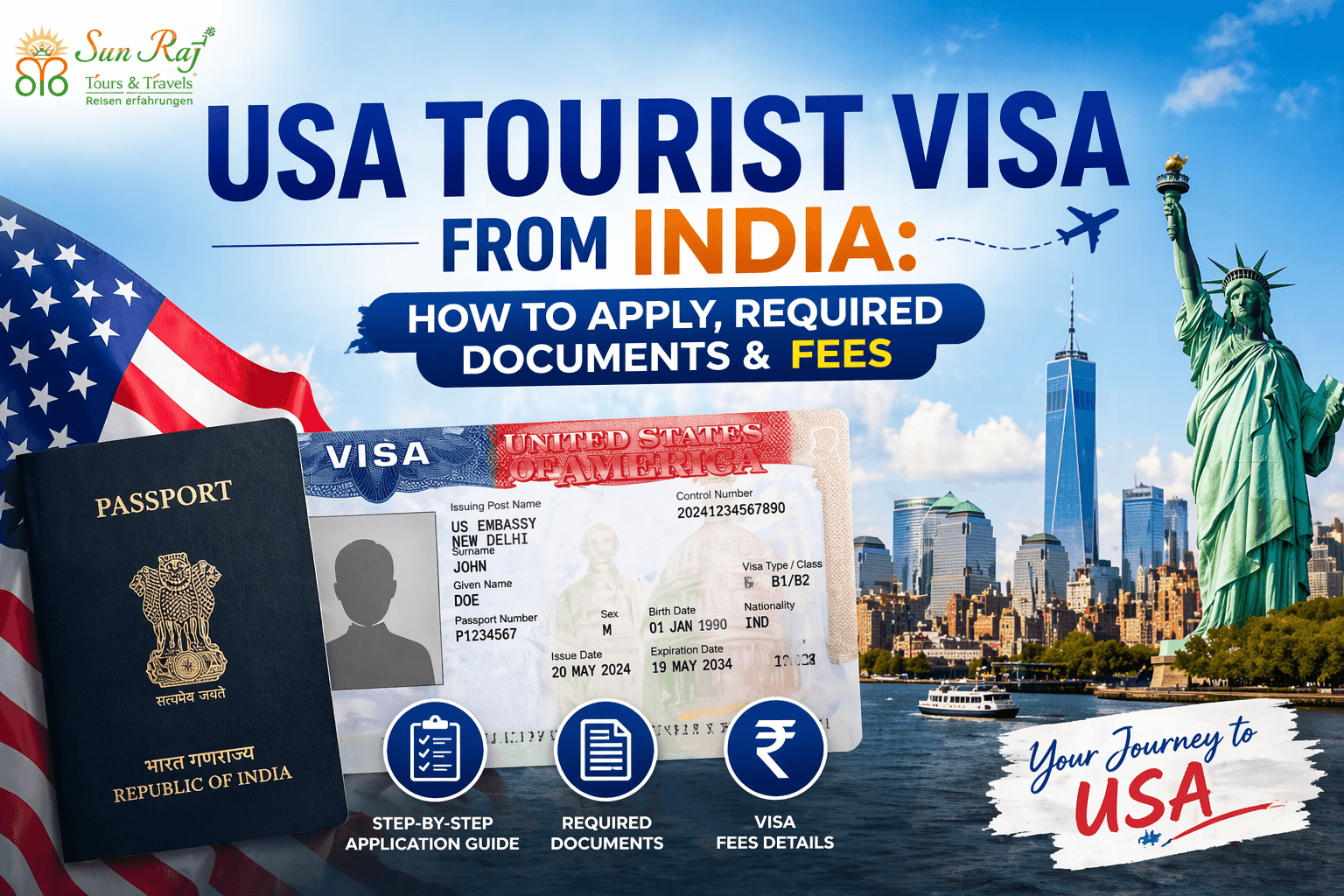
USA Tourist Visa from India: How to Apply, Required Documents & 2026 Fees
New York City. The Grand Canyon. Niagara Falls. Yellowstone. Times Square on New Year’s Eve.
The United States has been on the travel wish lists of millions of Indians for decades. And yet, for a lot of people, the tourist visa for the USA from India process feels like a maze, long waits, confusing forms, an interview that feels like an exam, and now, in 2026, a significant jump in fees.
Here is what most guides will not tell you upfront: interview wait times at some Indian consulates have crossed 9 months for a B1/B2 visa. And a new $250 Visa Integrity Fee, introduced under the US ‘One Big Beautiful Bill Act’, is set to push the total cost of a US tourist visa to roughly $435 per person once implemented.
If you are planning a USA trip in 2026, the single most important thing you can do right now is start your application early. Every week of delay means a longer wait in the interview queue.
This guide covers everything you need to apply for a tourist visa for the USA from India: eligibility, the full document checklist, a step-by-step application walkthrough, current fees, interview preparation, and the most common reasons applications get rejected. Read it once, follow it carefully, and your application will be in far better shape than the average submission.
What Is the US B1/B2 Tourist Visa?
The B1/B2 visa is the non-immigrant visitor visa that allows Indian citizens to travel to the United States temporarily. It combines two purposes under one visa category:
- B1 – Business: Attending meetings, conferences, training programs, and negotiations
- B2 – Tourism: Sightseeing, family visits, medical treatment, attending cultural or social events
Most Indian applicants apply for the combined B1/B2 visa, which gives flexibility to travel for both purposes without needing separate applications.
The B1/B2 visa does not allow you to work in the US. It does not allow full-time study. And it does not guarantee a specific length of stay – the duration of each visit is decided by the US Customs and Border Protection (CBP) officer at the port of entry.
Key Facts at a Glance
- Visa Type: Non-immigrant B1/B2 Visitor Visa
- Stay Duration: Up to 6 months per entry (CBP officer decides)
- Visa Validity: Up to 10 years for most Indian applicants
- Entry Type: Multiple-entry
- Interview: Mandatory for almost all first-time applicants as of September 2025
- Processing: 3–5 working days after interview (if approved); administrative processing may extend this
- Work Allowed: No
- Study Allowed: Short recreational courses only – no full-time academic programs
Eligibility Criteria for the Tourist Visa for USA from India
Before gathering documents, confirm you meet these baseline requirements. US consular officers assess all B1/B2 applications against these criteria:
1. Temporary Intent
You must demonstrate that your visit is genuinely temporary. US law presumes every visa applicant intends to immigrate. Your job is to prove otherwise — through your ties to India, your financial situation, and the specifics of your travel plans.
2. Valid Indian Passport
Your passport must be valid for at least 6 months beyond your intended return date from the US. It should have at least two blank pages available. If your passport is expiring within 6 months of your planned trip, renew it before applying.
3. Sufficient Financial Resources
You must show you can fund your entire US trip without working there. The amount expected depends on your travel duration and itinerary, but as a general guide:
- Solo Traveller (1–2 weeks): Minimum ₹3–5 lakhs in liquid savings (approximately $4,000–$6,000)
- Family of 4 (2 weeks): Minimum ₹12–15 lakhs accessible funds
- Consistent, organic savings over 6 months are more convincing than a recently inflated balance
4. Strong Ties to India
This is the single most assessed factor in any tourist visa for USA from India application. The consular officer needs to be persuaded you will return to India. Ties include:
- Stable employment with an employment letter and approved leave
- Business ownership with registration and financial documents
- Property ownership – house, land, commercial premises
- Immediate family in India – spouse, children, parents
- Fixed deposits, long-term investments, or pension income
5. Clean Legal History
No criminal conviction, no prior US visa violations (including overstays), and no undisclosed previous visa refusals. Always be honest. Misrepresentation can lead to a permanent ban from entering the US.
USA Tourist Visa Documents – Complete Checklist
A complete, well-organized document package significantly improves your chances. Below is the full usa tourist visa documents checklist for Indian applicants:
Core Mandatory Documents
- DS-160 Confirmation Page: Printed with the barcode clearly visible. This is the standard US non-immigrant visa application form, completed entirely online at ceac.state.gov
- Valid Indian Passport: Original, with 6+ months validity and at least 2 blank pages
- Old Passports: Bring all previous passports – they show your international travel history
- MRV Fee Payment Receipt: Proof that you have paid the visa application fee
- Appointment Confirmation: Both your VAC (biometrics) slot and embassy interview slot
- Passport-Size Photograph: Must meet US visa photo specifications: 2″ x 2″ (51mm x 51mm), white background, taken within the last 6 months, no glasses, neutral expression
Financial Documents
- Last 6 months of personal bank statements — stamped and e-verified
- Salary slips for the last 3 months (if salaried)
- Income Tax Returns for the last 2–3 years
- Form 16 or ITR acknowledgment
- Fixed deposit certificates or investment statements
- Property documents — not mandatory but strongly recommended
Avoid depositing large lump sums just before applying. US consular officers are specifically trained to identify sudden balance inflation. Consistent monthly credits tell a far more convincing story.
Employment and Income Proof
For salaried employees:
- Employment letter on company letterhead – stating your designation, joining date, salary, and approved leave dates
- Last 3 months’ payslips
For self-employed applicants:
- Business registration certificate (GST, MSME, or company registration)
- Recent business bank statements
- Business tax filings (last 2–3 years)
For students:
- Bonafide/enrollment certificate from your institution
- No Objection Certificate (NOC)
- Proof of sufficient funds (sponsor’s documents if family-funded)
For retired applicants:
- Pension statements (last 3 months)
- Property ownership or fixed income documents
Travel and Itinerary Documents
- Detailed travel itinerary — cities, dates, planned activities
- Return flight booking confirmation
- Hotel bookings or accommodation confirmation in the US
- Travel insurance policy (not mandatory but strongly recommended)
- Tour package details, if traveling with a group or agency
Purpose-Specific Documents
If visiting family or friends in the US:
- Invitation letter from your US-based host
- Proof of your host’s US status (US passport copy, Green Card, or visa)
- Proof of relationship (photographs, correspondence, family photos)
- Host’s financial documents (if sponsoring your trip)
If attending a business event:
- Invitation letter from the US company or conference organizer
- Business meeting schedule or conference registration proof
If seeking medical treatment:
- Diagnosis letter from your Indian physician explaining why US treatment is required
- Appointment confirmation from the US medical facility
- Proof of financial ability to cover treatment costs
Organize all documents in clearly labeled folders or sections. Present them in a logical order – identity documents first, financial documents second, travel documents third. Officers appreciate clarity.
How to Apply for Tourist Visa for USA from India: Step-by-Step
Here is the complete process for how to apply tourist visa for usa from india in 2026. Follow each step in order.
Step 1 – Complete Form DS-160
Go to ceac.state.gov and fill out Form DS-160 online. This is the official US non-immigrant visa application form. It covers your personal details, travel history, employment, family information, and social media presence.
Key points to note:
- The DS-160 form now includes additional social media history questions going back five years
- Answer all questions honestly and completely — inconsistencies between your DS-160 and your interview answers cause immediate red flags
- Once submitted, print the confirmation page with the barcode — you will need this at both the VAC and the embassy interview
- Do not make assumptions or leave fields blank without a valid reason
Step 2 – Pay the MRV Visa Application Fee
Pay the MRV (Machine-Readable Visa) fee of $185 through the official US visa payment portal. In India, this is typically paid through the USVISA-INFO portal managed by VFS Global.
Save your payment receipt carefully. You will need it to book your visa appointment. The MRV fee is non-refundable — even if your application is denied.
Note on the Visa Integrity Fee: A new $250 fee is being introduced for most non-immigrant visas under the One Big Beautiful Bill Act. As of April 2026, this fee has not yet been activated at Indian consulates. It is expected to be collected at the time of visa issuance — meaning only applicants who are approved will pay it. Monitor the official US Embassy India website for the implementation date.
Step 3 – Create Your US Visa Account and Schedule Appointments
Go to usvisa-info.com and create an account. You will schedule two appointments:
- Appointment 1 — VAC (Visa Application Centre): This is where you submit your biometrics (fingerprints and photograph). VFS Global manages VAC centres across India — in Mumbai, New Delhi, Chennai, Hyderabad, Kolkata, Ahmedabad, Bengaluru, Chandigarh, Hyderabad, Pune, and more.
- Appointment 2 — Embassy/Consulate Interview: The in-person visa interview at the US Embassy or Consulate in India. This is the most critical step in the process.
US Consulates in India that handle B1/B2 applications: Mumbai, New Delhi, Chennai, Hyderabad, Kolkata.
Interview wait times for B1/B2 visas at Indian consulates are significantly long in 2026, particularly in Mumbai. Apply as early as possible — ideally 10–12 months before your intended travel date.
Step 4 – Gather and Organize Your Documents
Use the checklist in the previous section. Have all documents physically organized for your VAC appointment and your interview. Do not print anything in poor quality or small font. Scan originals at 300 DPI if any digital submission is needed.
Step 5 – Attend Your VAC Appointment
At the Visa Application Centre, you will:
- Submit your biometrics — fingerprints and a digital photograph
- Verify your appointment and identity documents
- Pay any applicable VFS service charges at this stage
Your biometrics remain valid for 10 years once collected. If you have previously provided US visa biometrics, you may not need to repeat this step.
Step 6 – Attend Your Consulate Interview
The embassy interview is the most important step. A consular officer will ask you a series of questions about your application. Answer specifically, honestly, and concisely. This is not a conversation — keep responses focused.
See the interview preparation section below for the most common questions and how to approach them.
Step 7 – Await the Decision and Passport Return
After a successful interview, most approved applicants receive a decision within 3–5 working days. Passport delivery (with the visa sticker) typically takes an additional 2–4 working days via courier.
Some applications go into administrative processing — which can extend the timeline to several weeks without prior notice. If this happens, you will be informed at the interview or via email. There is no way to expedite administrative processing; you simply wait.
If your passport is ready, you can collect it from the VFS centre or have it couriered to your address. As of August 2025, third-party passport collection is no longer permitted — only the applicant or their immediate family member can collect the passport.
USA Tourist Visa Fees for Indian Applicants in 2026
The usa tourist visa fees structure has changed significantly in 2026. Here is a full breakdown:
| Fee Component | Amount (USD) | Approx. INR |
| MRV Application Fee | $185 | ₹15,500–₹16,500 |
| Visa Integrity Fee* | $250 | ₹21,000 approx. |
| Total per applicant | $435 (approx.) | ₹36,000–₹40,000 |
| VFS Service Charge | ~$25–$35 | ₹2,000–₹3,000 approx. |
* The $250 Visa Integrity Fee has been legislated under the One Big Beautiful Bill Act but is not yet being collected at Indian consulates as of April 2026. It will be charged at visa issuance (not at application), so rejected applicants will not pay it. Verify the current status at in.usembassy.gov before applying.
Additional optional costs to factor into your budget:
- VFS courier service for passport return: ₹500–₹1,500 approx.
- Optional VFS premium services: variable
- Travel insurance: ₹2,000–₹8,000 depending on coverage and duration
The MRV fee ($185) is non-refundable regardless of your visa outcome. Budget this as a sunk cost before you apply.
Visa Interview Wait Times in India — 2026
This is the part most applicants discover too late. B1/B2 interview wait times at Indian consulates are among the longest in the world. Here are the approximate wait times as of early 2026:
| Consulate | B1/B2 Wait (Approx.) | Remark |
| Mumbai | 9–10 months | Highest volume in India |
| New Delhi | 3–6 months | Improving; peak season longer |
| Chennai | 3–4 months | Some B1/B2 slots N/A |
| Hyderabad | 3–5 months | Improving after new slots |
| Kolkata | 2–4 months | Relatively shorter |
If you are applying from Mumbai, you may be waiting 9–10 months for a B1/B2 interview slot. Start your application well over a year before your intended travel date. Alternatively, check if another consulate has shorter queues — you are not required to apply at the consulate nearest to your city of residence.
How to Prepare for the US Visa Interview?
The consular interview is the most decisive moment in your tourist visa for USA from India application. Officers ask rapid-fire questions and form impressions quickly. Preparation matters.
What to Bring
- Original passport and all old passports
- DS-160 confirmation page (with barcode)
- Appointment confirmation letter
- MRV fee payment receipt
- Complete document set — financial, employment, itinerary, purpose-specific
- Passport-size photographs
Common Interview Questions
Be ready to answer these clearly and concisely:
- What is the purpose of your visit to the US?
- Where will you be staying? Do you know anyone there?
- How long do you plan to stay?
- What do you do in India? Where do you work?
- Who is sponsoring your trip?
- How much money are you carrying? What is your bank balance?
- Have you traveled outside India before?
- Do you have any family members in the US?
- What will you do when you return to India?
- Have you ever been refused a US visa before?
How to Answer Well
- Be specific: “I plan to visit New York for 5 days, then Los Angeles for 4 days, and return on 2026” — not just “I want to see America”
- Be honest: If you have a relative in the US, say so. Do not hide family connections — it raises more suspicion if discovered
- Be brief: Officers move fast. Answer the question asked. Do not volunteer extra information
- Show ties to India clearly: Mention your job, your family here, your property — anything that makes it obvious you have strong reasons to return
- Stay calm: A nervous answer is not automatically a red flag, but panicking and changing your story is
Practice your answers out loud before the interview. Do not memorize scripts — officers can tell. Instead, know the facts of your application so well that you can answer any question naturally.
Common Reasons for US Tourist Visa Rejection – and How to Avoid Them
Section 214(b) of the US Immigration and Nationality Act is the most common reason for B1/B2 visa refusal. It means the officer was not satisfied that you would return to India after your visit. Here are the most frequent triggers:
1. Weak or Absent Proof of Ties to India
If you cannot convincingly demonstrate that you have strong reasons to come back — a job, a family, property, a business — the visa is typically denied.
Fix: Submit an employment letter with approved leave, property documents, and mention immediate family members in India. Connect the dots for the officer — do not assume they will.
2. Insufficient Financial Proof
Low balances, sudden large deposits, or accounts with no consistent income pattern all raise concerns.
Fix: Show consistent monthly credits over 6 months. Include ITRs and fixed deposit certificates. If a sponsor is funding the trip, provide a properly written sponsorship letter along with the sponsor’s financials.
3. Vague Travel Purpose
“I want to tour the US” with no specific itinerary, no hotel bookings, and no clear plan is not enough.
Fix: Create a day-by-day itinerary naming specific cities and attractions. Include hotel bookings. If visiting family, have a clear invitation letter with specific dates.
4. Prior Visa Refusals Not Declared
The DS-160 form asks about previous visa refusals. Not declaring a prior refusal — for any country — is treated as misrepresentation and can result in a long-term bar.
Fix: Always declare prior refusals. Address the previous reason for rejection directly in your cover letter and show how your circumstances have changed.
5. Inconsistency Between DS-160 and Interview Answers
Officers compare your form answers against your spoken responses. Contradictions — even minor ones — create doubt.
Fix: Review your completed DS-160 carefully before your interview. Know every answer on that form. If you realize you made an error after submission, bring a written correction note to the interview.
6. No Prior International Travel History
First-time international travelers are considered higher risk because there is no track record of respecting visa conditions.
Fix: If this is your first trip abroad, compensate with exceptionally strong financial and employment documentation. A well-written cover letter explaining your travel purpose can also help.
7. Social Media Inconsistencies
As of 2025, social media screening is applied to all non-immigrant visa categories. Public posts that suggest an intent to work or stay in the US beyond your visa duration can hurt your application.
Fix: Ensure your public social media presence is consistent with your stated purpose. Remove or archive any content that might suggest otherwise.
Expert Tips for a Stronger US Tourist Visa Application
Apply 10–12 Months in Advance
With B1/B2 interview wait times at Mumbai consulate stretching to 9–10 months, applying early is not just advice – it is a necessity. Do not apply to meet a fixed travel date. Apply first, then plan your trip.
Write a Cover Letter
A short, factual cover letter accompanying your application sets context for the officer before the interview. Introduce yourself, state your purpose, name your specific travel plans, confirm your ties to India, and express your intent to return. Keep it to one page.
Book Refundable Tickets and Accommodation
Do not book non-refundable flights or hotel stays until your visa is in hand. Most travel bookings offer a provisional or refundable option – use it. A provisional flight booking is acceptable for visa applications.
Get Travel Insurance
While travel insurance is not a mandatory usa tourist visa requirement, it covers medical emergencies, trip cancellations, lost luggage, and more. Medical costs in the United States are extremely high. One emergency room visit can cost thousands of dollars. Travel insurance is not optional — it is essential.
Our overseas travel insurance services include plans specifically designed for USA travel. Speak to us about the right coverage before your interview.
Work with a Trusted Travel Partner
Managing the tourist visa for USA from India process alongside work and personal commitments is stressful. A reliable travel agency helps you stay on top of document requirements, form deadlines, and appointment scheduling.
The SunRaj Travels team has been helping Indian travelers with visa applications, flight bookings, hotel reservations, and forex for over 15 years. Explore our visa services for end-to-end support, or browse our international tour packages for ready-made USA itineraries.
After Your US Tourist Visa Is Approved
Congratulations – your B1/B2 visa is stamped. Here is what comes next:
- Check your visa label carefully: Confirm your name, passport number, validity dates, and number of entries are exactly correct. Errors must be flagged immediately.
- Book your flights: Our international air ticket booking service covers all major airlines flying from India to the US – Mumbai, Delhi, Bengaluru, and Hyderabad to New York, Los Angeles, Chicago, San Francisco, and more.
- Confirm your accommodation: Our hotel reservation services cover hotels across all major US cities and tourist destinations.
- Arrange forex: Get US Dollars at competitive exchange rates before you travel. Our forex services offer multi-currency cards and cash for international travel.
- Know the rules at US entry: Carry all your original documents when you fly. The CBP officer at the port of entry decides your permitted duration of stay — typically up to 6 months. Be honest about your purpose and how long you plan to stay.
- Do not overstay: Overstaying your permitted duration — even by a day — can result in a multi-year bar on entering the US and will affect future visa applications for any country.
Frequently Asked Questions
Do Indian citizens need a visa to travel to the USA?
Yes. Indian passport holders must obtain a valid US visa before entering the United States. There is no visa-on-arrival option for Indian citizens. The most common visa for tourism and family visits is the B1/B2 visitor visa.
What is the tourist visa fee for USA from India in 2026?
The standard MRV application fee is $185 (approximately ₹15,500–₹16,500). A new $250 Visa Integrity Fee has been introduced under the One Big Beautiful Bill Act, potentially bringing the total to $435 per person. As of April 2026, the Integrity Fee has not yet been activated at Indian consulates. Verify the current status at the official US Embassy India website before applying.
How long does the US tourist visa process take from India?
The process has two stages. Getting an interview slot is currently taking 3–10 months depending on the consulate. Post-interview processing typically takes 3–5 working days if approved. Some applications go into administrative processing, which can take several additional weeks.
What documents are required for a US tourist visa from India?
The core usa tourist visa documents include: DS-160 confirmation page, valid passport, MRV fee receipt, appointment confirmation, passport photograph, last 6 months’ bank statements, salary slips or business documents, ITRs, employment letter, travel itinerary, hotel bookings, and return flight confirmation. Additional documents depend on your purpose of visit.
Is the US visa interview mandatory for Indian applicants?
Yes. As of September 2, 2025, in-person interviews are mandatory for nearly all non-immigrant visa applicants, including B1/B2 tourist visas. Interview waivers have been eliminated for most applicants, though limited exceptions may apply for certain visa renewals.
Can I apply for a US tourist visa if I was previously refused?
Yes. A previous refusal does not permanently bar you from reapplying. However, you must declare the prior refusal on your DS-160. Reapplying with the same documents and profile as your rejected application rarely results in a different outcome. Address the specific reason for the refusal in your new application.
What is the Visa Integrity Fee for USA visa?
The Visa Integrity Fee is a new $250 charge introduced under the US One Big Beautiful Bill Act. It is levied at the time of visa issuance – meaning only applicants who are approved will pay it. Rejected applicants do not pay this fee. As of April 2026, the fee has not yet been implemented at Indian consulates. The system to collect the fee is still being set up.
Can I apply at any US Consulate in India?
Yes. You are not restricted to the consulate nearest your city. If Mumbai has a 9-month wait, you may check availability at Delhi, Chennai, Hyderabad, or Kolkata. Check real-time slot availability at usvisa-info.com to compare wait times.
Is travel insurance required for a US tourist visa?
Travel insurance is not a mandatory document for the US B1/B2 visa application. However, given the high cost of medical care in the United States, it is one of the most important things any Indian traveler can purchase before flying. Our overseas travel insurance services include comprehensive plans for USA travel.
How long can I stay in the US on a B1/B2 tourist visa?
The visa validity (up to 10 years) is not the same as your permitted stay duration. The CBP officer at the US port of entry decides how long you can stay on each visit – typically up to 6 months. Do not overstay this permitted period.
Planning Your USA Trip? SunRaj Travels Can Help
The process for obtaining a tourist visa for the USA from India requires patience, preparation, and a fair amount of paperwork. But once your visa is approved, one of the world’s most iconic travel destinations is yours to explore.
The SunRaj Travels team has been assisting Indian travelers since 2010 – with visa support, international tour packages, flight bookings, hotel reservations, travel insurance, and forex. We know the process well, and we are here to help you get it right the first time.
Start with our visa services, explore USA tour packages, get your travel insurance sorted, and check out our forex services for competitive USD rates before your trip.

Recent Posts
USA Tourist Visa from India: How to Apply, Required Documents & 2026 Fees

Common Reasons for Visa Rejection in the USA, UK & Schengen
Visa Processing Time Comparison: USA, Japan, UK, Canada & Australia for Indian Travelers (2026)
Tags

Thailand
