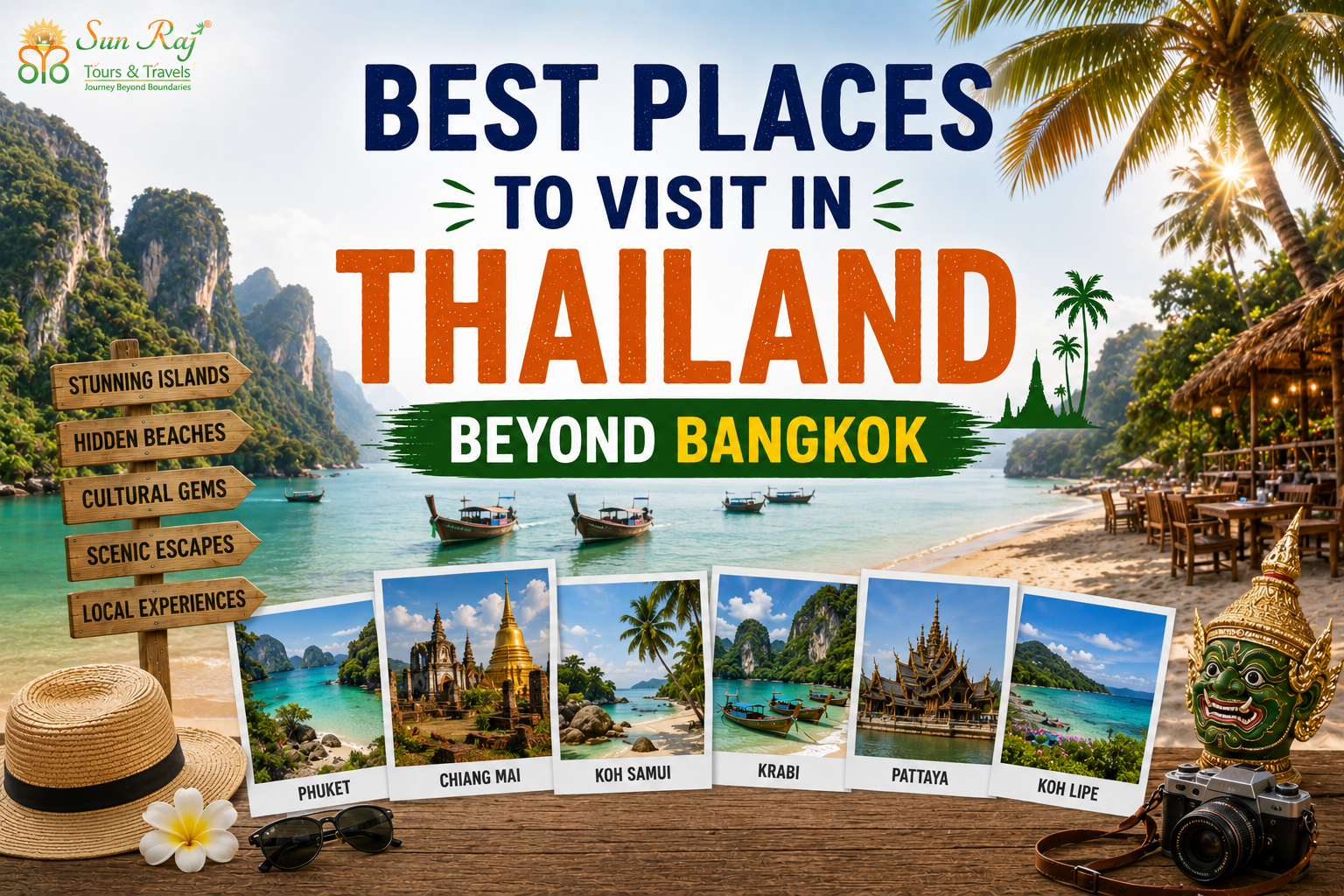
Most people plan a Thailand trip around Bangkok. They visit the Grand Palace, eat Pad Thai on Khao San Road, and come home thinking they’ve seen the country.
They haven’t.
Thailand stretches across 513,000 square kilometers. It has misty northern mountains, ancient temple ruins, jungle waterfalls, and some of the most stunning island chains in all of Southeast Asia. The best places to visit in Thailand go far beyond the capital, and that’s exactly what this guide is about.
Whether you are travelling for the first time or going back for more, you’ll find something new here. This is a complete look at the 10 best places to see in Thailand, with practical tips for each destination.
Why Thailand Still Tops Every Travel List?
Thailand welcomed over 35 million tourists in 2024. The numbers keep rising. Why?
Because the country genuinely has it all. You can spend a morning inside a 700-year-old Buddhist temple. By afternoon, you can be on a white sand beach. By evening, you can be eating street food from a market stall that has a Michelin Bib Gourmand rating.
The food is exceptional. The people are welcoming. The cost of travel is manageable for most budgets. And the infrastructure, flights, ferries, trains, and buses, make getting around easier than you’d expect.
That combination is hard to beat.
The 10 Best Places to Visit in Thailand
1. Phuket — Thailand’s Island Capital

When people search for the best places to visit in Thailand, Phuket always tops the list. It is Thailand’s largest island, connected to the mainland by a bridge, and served by its own international airport.
The island has something for almost everyone.
Beaches: Patong is the busiest and best-known. Kata and Kamala are calmer. Surin is upscale. If you want near-empty sand, drive to the north of the island to Nai Thon or Natai.
Island Hopping: Day trips to Phi Phi Islands and the Similan Islands leave from Phuket’s piers. The Phi Phi Islands are some of the most photographed spots in all of Asia.
Nightlife: Patong Beach Road is one of the most active nightlife strips in Southeast Asia. It starts early and ends late.
Old Phuket Town: This is the part most visitors skip. The Sino-Portuguese shophouses, independent cafes, and street murals are genuinely charming. Spend at least half a day here.
Best time to go: November to March, when the Andaman Sea is calm and the skies are clear.
2. Chiang Mai — Northern Thailand’s Cultural Heart
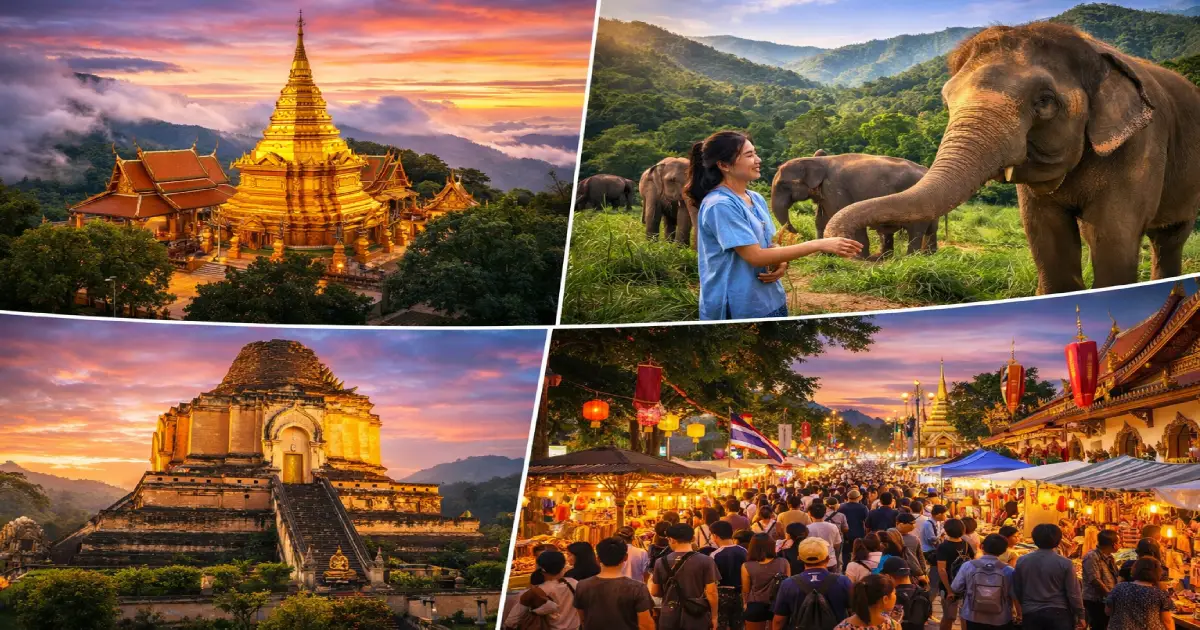
Chiang Mai sits in a valley surrounded by forested mountains. It is the cultural capital of northern Thailand and one of the most beloved destinations in the entire country.
The city has over 300 Buddhist temples within its old city walls. Wat Phra That Doi Suthep, perched on a mountain above the city, is the most iconic. The views from the top extend across the valley on a clear day.
Night markets are a highlight. The Sunday Walking Street on Wualai Road is one of the largest markets in Thailand. The Night Bazaar runs every evening.
Ethical elephant experiences operate in the hills around Chiang Mai. Unlike elephant riding, the responsible sanctuaries let you feed, walk with, and bathe elephants without any harmful training methods.
Cooking classes are everywhere and genuinely enjoyable. Spending a morning in a Thai cooking school, often including a market visit, is one of the better half-day activities in Thailand.
Chiang Mai also has a growing coffee culture, excellent restaurants, and a popular co-working scene that keeps digital nomads returning year after year.
Note: Avoid visiting between January and March if you are sensitive to air quality. Smoke from agricultural burning affects the region during these months.
3. Krabi — Limestone Cliffs and Emerald Water

Krabi Province sits on Thailand’s Andaman coast. It is quieter than Phuket but equally beautiful, and, for many travellers, more so.
The signature landscapes are the towering limestone karst formations that rise directly from the sea. Railay Beach is the most famous example. It is accessible only by longtail boat, which keeps it free of motor traffic. The result is a beach that feels genuinely peaceful even during peak season.
Ao Nang is the main town and the easiest base. From here, you can join the famous 4-Island Tour, take a kayaking trip through mangroves, or hike to Tiger Cave Temple, 1,237 steps to the summit, and a view that earns every single one of them.
Rock climbing on the limestone cliffs around Railay is world-class. Krabi has some of the most sought-after sport climbing routes in Asia.
Best time to go: November to April.
4. Koh Samui — Gulf of Thailand’s Signature Island

While Phuket dominates the Andaman coast, Koh Samui leads on the Gulf of Thailand side. It is more developed than most Thai islands but also well-served by a domestic airport, making it easy to reach.
Chaweng Beach is the busiest strip. Bophut, also called Fisherman’s Village, is slower, more charming, and lined with good restaurants. Lamai Beach sits between the two in terms of activity level.
Big Buddha Temple (Wat Phra Yai) is the island’s most photographed attraction. The 12-metre-tall golden statue sits on a small islet connected to the main island by a causeway.
Koh Samui is a popular base for diving trips to Koh Tao, which has some of the most affordable dive certification courses in the world. Koh Phangan, famous for its Full Moon Party, is a short ferry ride away.
Best time to go: January to September. The Gulf side has a different monsoon pattern to the Andaman coast.
5. Chiang Rai, The White Temple and Beyond

Chiang Rai is Thailand’s northernmost major city. It sits close to the borders of both Myanmar and Laos. Most visitors come for one reason: Wat Rong Khun, known as the White Temple.
It is unlike any temple in Thailand. The entirely white and mirrored structure is the work of artist Chalermchai Kositpipat, who has been building it since 1997. It is still unfinished and planned to take several more decades. Parts of the interior include murals featuring contemporary figures alongside traditional Buddhist imagery.
Blue Temple (Wat Rong Suea Ten) is nearby and equally striking, vivid cobalt blue inside and out, with golden Buddha statues.
The Golden Triangle, where Thailand, Laos, and Myanmar meet at the confluence of two rivers, is a short drive from the city. The area has a fascinating opium trade history, which is now covered in the Hall of Opium museum.
Chiang Rai has a calm, unhurried feel that many travellers prefer after the bustle of Bangkok or Chiang Mai.
6. Pai, The Mountain Town That Wins Every Heart

Pai is a small town in Mae Hong Son Province, about three hours north of Chiang Mai by road. The drive alone, through 762 curves, is memorable.
The town sits in a valley ringed by mountains and rice fields. It attracts a mix of backpackers, yoga seekers, and travellers who came for two days and stayed for two weeks.
The pace here is deliberately slow. The main street has coffee shops, vegetarian restaurants, and guesthouses. Outside town, you will find hot springs, bamboo bridges, canyon viewpoints, and the remains of a World War II memorial bridge.
Pai Canyon is best at sunset. The narrow ridgelines and deep drops make for dramatic walking.
Best suited for: Travellers who want a quiet contrast to beach or city tourism.
7. Ayutthaya — The Ancient Capital

Ayutthaya is the most historically significant destination on this list. It was the capital of the Kingdom of Siam for over 400 years, from 1350 to 1767, before being destroyed by Burmese invaders.
What remains is one of Southeast Asia’s most atmospheric archaeological sites. Headless Buddha statues, crumbling prangs (towers), and vine-covered walls stretch across the city. The most iconic image, a Buddha head nestled in the roots of a Bodhi tree at Wat Mahathat, is one of Thailand’s most photographed sights.
Ayutthaya is just 80 kilometres north of Bangkok. A day trip is possible, but an overnight stay lets you explore the ruins in the cooler morning light and without the day-trip crowds.
Getting there: Train from Bangkok’s Hua Lamphong or Bang Sue station. The journey takes about 90 minutes and costs very little.
8. Kanchanaburi, History, River, and Jungle

Kanchanaburi is often overlooked in favour of beach destinations. That is a mistake.
The town sits along the River Kwai, two hours west of Bangkok. It holds some of the most significant World War II sites in Asia. The Death Railway Bridge, known as the Bridge over the River Kwai, was built by Allied prisoners of war and Asian labourers under brutal conditions during the Japanese occupation. The adjacent JEATH War Museum and the Thailand-Burma Railway Centre are sobering and important.
Outside the town, the province opens up into beautiful jungle and river landscape. Erawan National Park is the main natural draw. Its seven-tiered waterfall with vivid turquoise pools is genuinely one of the most beautiful sights in Thailand.
Kanchanaburi is an excellent choice for travellers who want history, nature, and fewer tourists.
9. Koh Lanta — The Relaxed Alternative to Phuket

Koh Lanta is a long, narrow island in the Andaman Sea, south of Krabi. It lacks the infrastructure of Phuket or Koh Samui. That is part of its appeal.
The beaches are uncrowded. The pace is gentle. The food is excellent, particularly the seafood along the waterfront. The southern tip of the island is a national park with coral reefs suited to snorkelling.
Koh Lanta is popular with families and couples who want an island holiday without the full resort-town experience. Accommodation ranges from budget bungalows to well-designed boutique properties.
Best time to go: November to April.
10. Koh Tao, Thailand’s Diving Capital

No list of the top 10 destinations in Thailand is complete without Koh Tao. This small island, shaped roughly like a turtle (which is what its name means), is one of the most popular places in the world to learn to dive.
The reason is straightforward. The waters around Koh Tao have good visibility, reliable marine life, including whale sharks during certain seasons — and dozens of established dive schools offering internationally recognised PADI and SSI certifications at competitive prices.
Even if you do not dive, the snorkelling directly off the beaches is among the best you’ll find in Thailand without getting on a boat. Shark Bay (Ao Leuk) is particularly good for spotting blacktip reef sharks in shallow water.
The island has a vibrant social scene around its main village of Mae Haad and along Sairee Beach. It is small enough to explore fully in a few days.
Quick Comparison: Which Destination Suits You?
| You want… | Best destination |
| Beaches + nightlife | Phuket, Koh Samui |
| Temples + culture | Chiang Mai, Chiang Rai, Ayutthaya |
| Adventure + diving | Koh Tao, Krabi |
| History + nature | Kanchanaburi |
| Peace + mountains | Pai |
| Quiet island escape | Koh Lanta |
Practical Travel Tips for Thailand
Visa: As of 2026, Indian passport holders can enter Thailand visa-free for 60 days. Keep your onward or return ticket ready at immigration.
Currency: The Thai Baht (THB) is the local currency. ATMs are widely available. Carry some cash when visiting islands or national parks.
Transport: Bangkok has a BTS Skytrain and MRT metro. Between cities, budget airlines like AirAsia, Nok Air, and Thai Lion Air offer affordable connections. For islands, ferries and speedboats operate from mainland ports.
Sim card: Buy a local SIM at the airport on arrival. Data is fast, affordable, and available everywhere except the most remote islands.
Health: No mandatory vaccinations, but it is worth being up to date on Hepatitis A and Typhoid. Dengue fever is present. Use mosquito repellent at dawn and dusk.
Food safety: Eat where the locals eat. Street food is generally safe. Avoid raw salads at low-footfall spots.
Best Time to Visit Thailand
The best time for most of Thailand is November to February. Temperatures are manageable, skies are clear, and both the Andaman and Gulf coasts are accessible.
March to May is hotter but still good for beaches.
The monsoon runs from roughly June to October. The Andaman coast (Phuket, Krabi, Koh Lanta) is wetter during this period. However, the Gulf coast (Koh Samui, Koh Tao, Koh Phangan) often stays dry from July to September, a useful trick for off-season travellers.
For a detailed month-by-month breakdown including the best time to visit Thailand, Phuket, Bangkok, and the north, read our full guide: Best Time to Visit Thailand 2026: A Complete Month-by-Month Guide
Frequently Asked Questions
Q: What are the best places to visit in Thailand for first-time travellers?
A: Bangkok, Phuket, and Chiang Mai form the classic first-time triangle. Most first-timers start in Bangkok, head south to Phuket or Krabi for beaches, and fit in Chiang Mai if time allows.
Q: How many days do you need in Thailand?
A: Ten days is the minimum to cover two or three regions comfortably. Two weeks or more is ideal if you want beaches, mountains, and history.
Q: Is Thailand affordable for Indian travellers?
A: Very much so. Thailand is one of the most budget-friendly international destinations from India. A mid-range budget of ₹5,000 to ₹7,000 per day (excluding flights) covers comfortable accommodation, local transport, food, and entry fees.
Q: Which is better — Phuket or Krabi?
A: They suit different travel styles. Phuket is bigger, more developed, and has better nightlife. Krabi is more scenic, quieter, and better suited to couples or adventure travellers. Both are among the best places to visit in Thailand for beach holidays.
Q: Do I need to book Thailand in advance?
A: For peak season (December to February), booking accommodation and activities at least 4 to 6 weeks ahead is advisable. For shoulder and off-season, you have more flexibility.
Q: Is Thailand safe for solo female travellers?
A: Generally yes. Thailand is considered one of the safer destinations in Southeast Asia. Stick to well-reviewed accommodation, use Grab (the regional ride-hailing app) instead of unmarked taxis, and share your itinerary with someone at home.
Plan Your Thailand Trip with SunRaj Travels
Thailand has one of the richest travel experiences in all of Asia, and exploring it properly takes some planning. Whether you want a beach holiday in Phuket, a cultural tour through Chiang Mai and Ayutthaya, or an adventure-packed itinerary across multiple regions, the right package makes all the difference.
SunRaj Travels offers expertly designed Thailand tour packages from Mumbai that include flights, hotels, transfers, sightseeing, and visa assistance — so you focus on the experience, not the paperwork.
Speak to our team today and let us build an itinerary around the best places to visit in Thailand that match your budget, travel style, and timeline.